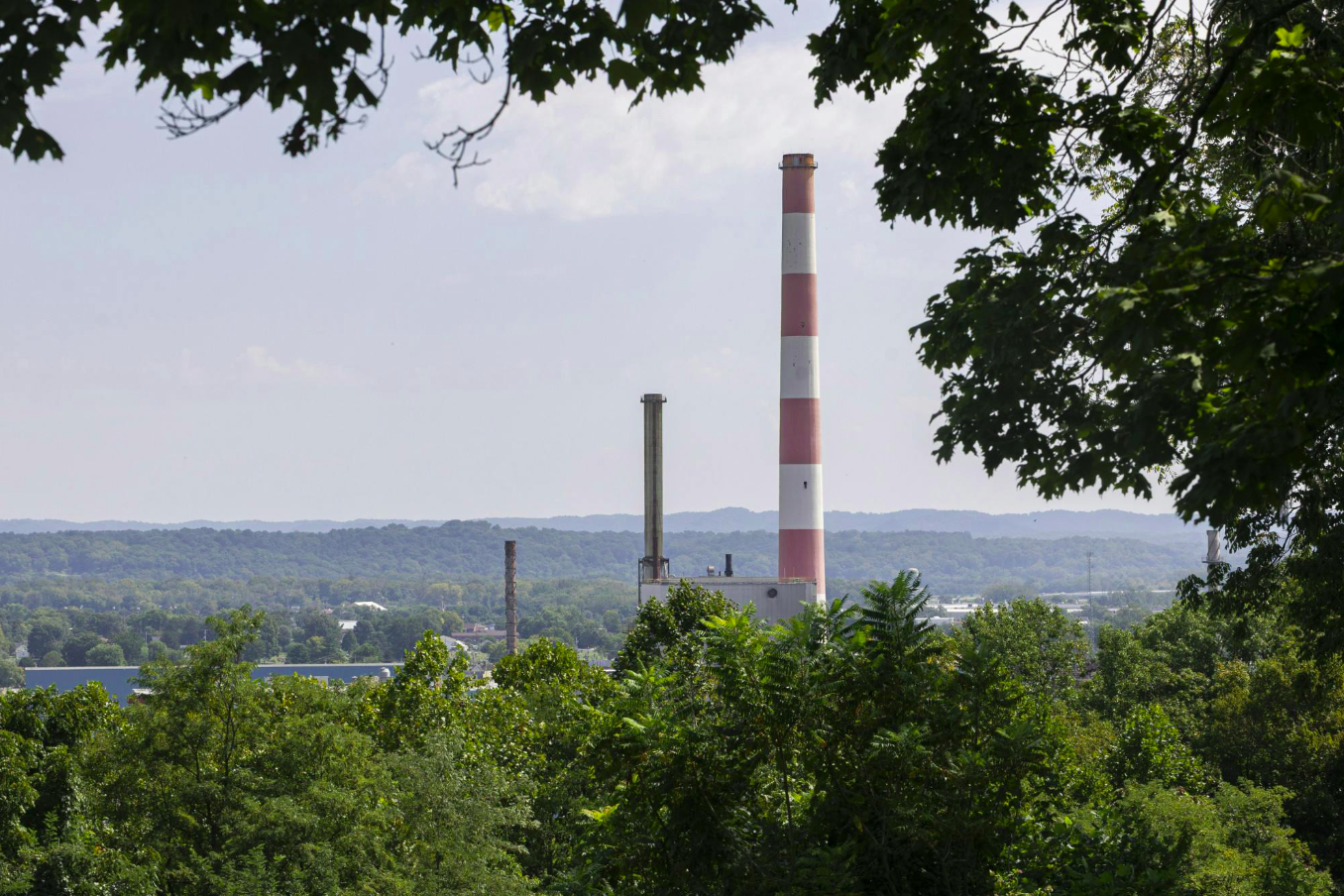
The red and white chimney of the former Pixelle Speciality Solutions paper mill looms over the city in Chillicothe, Ohio, Aug. 30, 2026. Last year, the plant was bought by U.S. Medical Glove Co. and is set to be converted into a manufacturing hub for multiple industries.
Photo by Ethan Herx | The Post
By Laynee Eslich- October 27, 2026 | 12:00am EDT
The POST -The Appalachian Ohio Manufacturers’ Coalition launched the Made in Appalachia program last month. The program trains individuals in behavioral health recovery to get manufacturing jobs.
According to Hunter Warsinsky, the workforce development manager at AOMC, the program already hired three people into manufacturing jobs since it began and offered about 30 training sessions.
The Ohio Department of Behavioral Health granted $3 million to the AOMC to create the program.
Warsinsky said a primary goal of the program is to address the need for essential manufacturing workers, which people in recovery programs can fill.
“There are currently 278,000 workers nearing retirement, and we're only going to have about 155,000 who are going to be entering the workforce,” Warsinsky said. “So we have a population gap of like 123,000. That's across all southeastern Ohio, and we realize that individuals in recovery and second chance, they're being overlooked to receive positions in manufacturing.”
The AOMC is a nonprofit that creates manufacturing opportunities throughout Ohio’s Appalachian region, including manufacturing internships, training, job shadowing and help with business funding and job searching.
Warsinsky outlined the process for accepting people into the Made in Appalachia program.
The nonprofit first connects participants with case managers to ensure they are ready for the next step in their recovery. Warsinsky said the program then meets with potential participants, evaluates obstacles they might face and provides training if they are deemed ready.
Once participants complete training, they are placed in a job. Warsinsky said AOMC provides support for them in the first six months to a year to ensure job retention.
The program bases job placement on an individual’s interests, according to Warsinsky. However, he said mill operation training provides participants with quick training if they are unsure what they want to pursue within manufacturing.
AOMC also implemented barrier-reduction into the program to identify obstacles preventing individuals from working and help them find solutions to those obstacles.
Colt Morningstar, AOMC’s workforce program coordinator, said he built connections with local services, such as the Ohio Department of Job and Family Services, to find accessible solutions for obstacles, including SNAP benefits, Medicaid eligibility and clothing vouchers.
“We're not just giving somebody a phone number for the resource,” Morningstar said. “We call the resource with them because we know how to navigate the system, and then we say, ‘Hey, this person needs this,’ or they need Medicaid or whatever the case is. We just give those warm handoffs and we help them as much as we can.”
Morningstar created a funding process, which makes any person who gets a certificate through the program eligible for a $1,200 stipend. Morningstar said participants often use this money for rent, transportation and other basic needs that contribute to their ability to work.
“At the end of the day, we're trying to get second-chance people an opportunity to have not just a job, but a career and also support them while they're trying to get it because a lot of people, it's not that they don't want to work or they can't get a job,” Morningstar said. “It's the fact that, you know, they just don't have any opportunity or help when trying to find a career or find a job.”
Warsinsky said the hardest part of the process is attempting to end the stigma around hiring someone in recovery.
“We call them second-chance, and it's like, well, how long does a person have to identify as a second-chance before we actually give them a second chance or like take that off of them,” Warsinsky said.
To aid in that, Morningstar created the Workforce Academy, a five-day training that covers interpersonal skills and financial education to prove the character and commitment of participants to manufacturers.
Morningstar served time in prison himself and said he faced stigma for his past.
“I didn't understand that you're still paying a debt even though society says you've already paid it, and I think just giving those people an opportunity to prove people wrong and show that they're worthy is really important, and I think we're making a big impact on that,” Morningstar said.
